
KUALA LUMPUR: At the Festival Irama Asli & Asal 2025 held here last month, Linda Angik’s deft fingers weave coconut leaves into a “tempok”, a traditional Orang Asli headgear, captivating onlookers.
The 50-year-old Temiar woman completes the headpiece in just 10 minutes. Using a simple weaving method, she crosses two leaves into an X, folds them into a V, and joins leaf by leaf until a circular band forms around the head.
“The orderly, repetitive hand movements reflect the precision of traditional weaving, still practised within our community,” she later told Bernama.
Having started making tempok at age 20, Linda said the accessory can be crafted from coconut leaves or mengkuang, depending on the design and materials.
“Each leaf is selected, trimmed and cleaned to ensure the wearer does not experience itchiness. Simple designs are easy to teach, while intricate ones need higher skill,” she added.
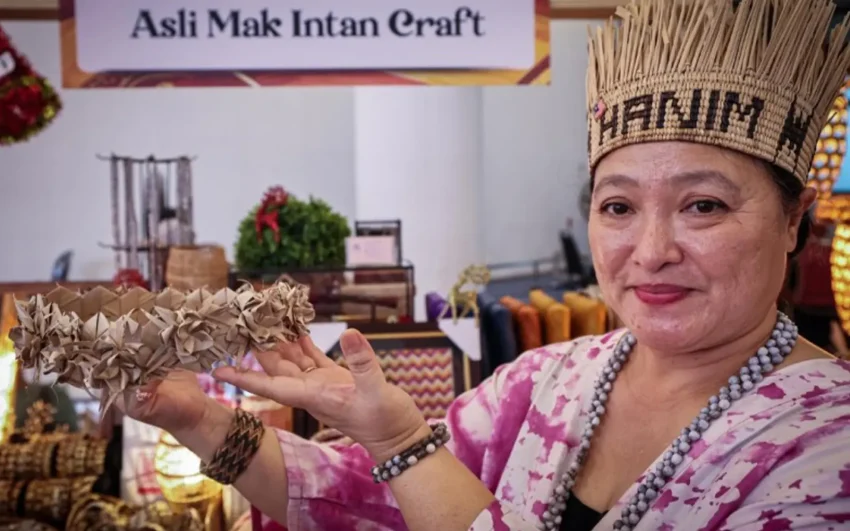
The tempok, also called tanjak, carries significance beyond decoration: it is an identity marker for peninsular Malaysia’s Orang Asli communities, whose traditions are increasingly eroded by modernisation.
“Wearing the tempok distinguishes our community from wider society and reflects the diversity of the 18 Orang Asli tribes,” said Hanim Apeng, vice-president of the Native Allies Society of Malaysia.
Hanim, a handicraft entrepreneur, added that traditionally, the tempok was worn outside the home as a symbol of community identity, only removed during sleep. Today, the practice is becoming rare, particularly among the younger generation.
“Many young people no longer wear this accessory. That is why we must constantly remind ourselves that this is an obligation, distinguishing us from outsiders,” she said.
Hanim stressed that every community member should know the basics of making a tempok, even in its simplest form, to ensure the craft survives.
“We try to teach young people to keep learning these skills, otherwise this art may disappear,” she said, expressing hope that more youths will pursue handicraft entrepreneurship.