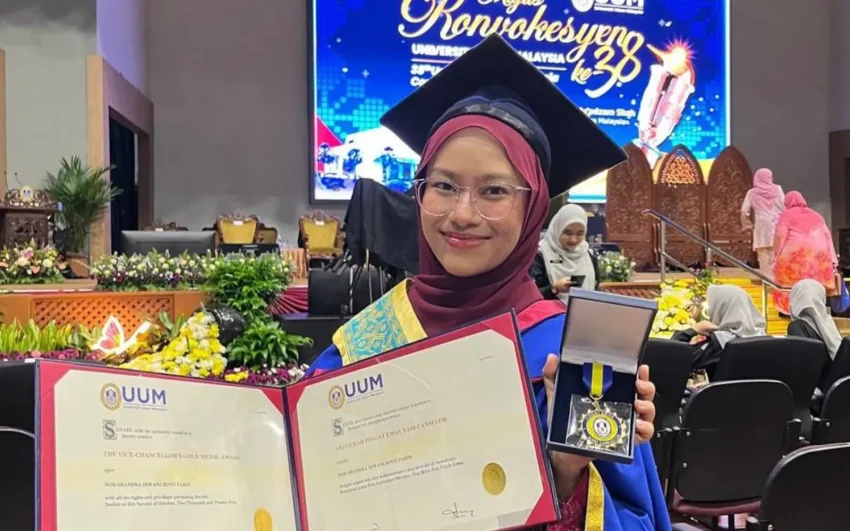
Nor Shamira Irwani Farid was diagnosed with stage 4 classic Hodgkin lymphoma when she was 24 years old. (Nor Shamira Irwani Farid pic)
PETALING JAYA: The moment felt surreal for Nor Shamira Irwani Farid. It was her convocation ceremony, and she was onstage at Universiti Utara Malaysia to receive the Vice-Chancellor’s Gold Medal Award from the Sultan of Kedah, Sultan Sallehuddin Sultan Badlishah.
She had spent four years working hard towards this achievement, graduating with an impressive CGPA of 3.94. Yet when the moment finally arrived, it was tinged with sadness.
Months earlier, the 24-year-old was diagnosed with stage 4 classic Hodgkin lymphoma, a cancer that affects the lymphatic system.
“As I held the gold medal in my hands, I had flashbacks of struggling through the side effects of chemotherapy – vomiting and lying in bed,” she told FMT Lifestyle.
Shamira with her stepfather and mother during her convocation ceremony earlier this month. (Nor Shamira Irwani Farid pic)
At one point, she wasn’t even sure she would make it to the ceremony. But after her doctor switched her to a less aggressive treatment, she had the strength to attend – turning what could have been a missed milestone into a moment she would never forget.
Shamira had been in her second year of her Bachelor of Social Work Management programme when she noticed a lump on her neck. A doctor prescribed a course of antibiotics, and recommended further checks if the lump didn’t disappear.
The lump remained. But Shamira, caught up with lectures and assignments, never got around to getting it checked.
Earlier this year, during her internship, she became aware of more lumps, this time on both sides of her neck. That’s when she knew she could no longer ignore it.
Since her diagnosis, Shamira’s father and brother have been a source of support. (Nor Shamira Irwani Farid pic)
She underwent a biopsy and just days after completing her internship, she received the crushing diagnosis: classic Hodgkin lymphoma. Those three words instantly altered the future she had envisioned after graduation.
“When I heard the diagnosis, the only question I had was, ‘Why me?’. My family has no history of this. Plus, I had earlier been diagnosed with bipolar disorder type 2. So, I wondered – why would God give me another illness?” recalled Shamira, who hails from Nilai, Negeri Sembilan.
Although she is now in remission from bipolar disorder, she shared that during her studies, she struggled with depression, insomnia and a lack of appetite.
“From the time I was diagnosed with bipolar disorder, I held on to hope – that I’ll get better and be happy again,” she said.
“Even after I was diagnosed with classic Hodgkin Lymphoma, I still felt optimistic. I told myself, ‘It’s okay, I can do this’. I was still active then – dressing up, going out, spending time with friends and family,” she added.
Shamira, seen here with her boyfriend and his mother, is all smiles after receiving the Vice-Chancellor’s Gold Medal Award from UUM. (Nor Shamira Irwani Farid pic)
But another blow soon followed: a CT scan revealed that her cancer was at stage 4 and had spread to her liver, lungs and spleen. Cysts were also discovered on her ovaries.
Even in that moment of despair, Shamira recognised a blessing in disguise. “Perhaps God showed me I have lymphoma because it was through the CT scan that the cysts on my ovaries were found,” she reflected.
“My body did its best to endure so I could finish my studies well,” said Shamira, adding that her dream is to become a lecturer in medical social work.
Throughout her darkest moments – when the side effects of chemotherapy felt unbearable – the unwavering support of her family, boyfriend, friends as well as former lecturers and colleagues kept her going. They were there for her when her hair fell out, when she was vomiting and when exhaustion overwhelmed her.
Shamira hopes her cancer will go into remission after completing her course of chemotherapy. (Nor Shamira Irwani Farid pic)
It’s a reality far removed from what most people in their twenties imagine, but Shamira continues to hold on to hope.
“I really hope that by going through chemotherapy, it will be enough to put me in remission,” said Shamira, the youngest of three children.
“For me, once you lose hope, you lose the will to keep going.”
So, when she walked off the stage with the gold medal in her hand that day, it wasn’t only a celebration of academic excellence. It was a quiet, yet powerful triumph over everything she had endured – and a reminder of the hope she still clings to.


Erleben Sie das Nonplusultra des Luxusspielens in unserem angesehenen Etablissement, wo die Grenzen zwischen Genuss
und Aufregung glücklich verschwommen sind. Von klassischen Tischspielen wie
Roulette und Black Jack bis hin zu modernen Spielautomaten, die dich auf
den Rand deines Sitzes halten werden, gibt es hier für jeden Spielertyp etwas.
Turniere könnt Ihr zwar jede Woche – allerdings nur am Sonntag – spielen.
Entdecken Sie ein unvergleichliches Spielerlebnis im Bad Füssing
Casino, wo jedes Detail sorgfältig gestaltet wurde, um Ihnen ultimativen Luxus zu bieten. Das Casino Bad Füssing ist von der Staatslotterie-
und Spielbankaufsicht Bayern (SLSV) lizenziert, einer Regulierungsbehörde,
die für die Überwachung aller Glücksspielaktivitäten im Bundesland verantwortlich ist.
Diese Methode bietet Spielern ein hohes Maß an Sicherheit, Geschwindigkeit und
Transparenz. Die Spielbank Bad Füssing bietet vor Ort Barzahlungen an, wobei Euro die akzeptierte Währung ist.
Hier, im Außenbereich, steht auch der Pavillon für
die Raucher.Gespielt wird mit Hilfe elektronischer Karten. Vor allem Urlaubs- und Kurgäste (60+) riskieren hier ein Spielchen, es kommen aber auch
Einwohner zu Besuch. An einem Tisch wird Texas Hold’em Poker gespielt,
mit einem Mindest-Buy-In von 100 Euro. In der Spielbank
Bad Füssing hat der Gast die Wahl zwischen dem französischem Roulettspiels (zwei Tische) oder dem amerikanischen Roulette (drei Tische).
Augenfällig ist hier das große Angebot des Roulettspiels, wofür insgesamt fünf Tische bereit stehen.
References:
https://online-spielhallen.de/top-9-online-casinos-in-deutschland-2025-serios-getestet/
No waiting for someone to leave the roulette table.
Out of all the game types, nothing showcases that creative spark quite like slot
themes. I’ve even included slots of various themes and categories.
These offer a full range of table games and slots in a physical setting.
The new bill in the New York State Senate, SB8412, includes an amendment allowing online casino gambling.
With changes to legalization in previous years,
there is additional hope for online casino gambling to
be legalized. They’re meant purely for entertainment and skill-building, making them a legal and enjoyable way to experience the excitement of casino games from home.
References:
https://blackcoin.co/best-online-casino-video-slots-history-and-rules/
Online pokies are digital versions of the classic slot machines you’d find in clubs or casinos.
We strive to provide accurate and unbiased information through our
independent research of online casino operators.
So, are you worried that you may not have that online pokies $10 deposit?
Choose your real money casino below.
From a massive AU$10,000 welcome offer to daily cashback and thousands of games,
this Aussie casino is all about giving you more to play
with. What really sets this site apart is its collection of online pokies, especially bonus buy games.
Skycrown is one of those Aussie online casinos that
just feels stacked from the get-go. They also offer a broad
mix of pokies, live games, and crypto support, so it deserves a spot on our
list. Except for the welcome package, you can also opt in for weekly reload bonuses,
live cashbacks, trivia games, and more. Only pokies contribute 100% of the
bonus wagering requirements, while live games
may not count at all toward bonus wagering.
References:
https://blackcoin.co/37_best-online-casinos-for-vip-players-2022_rewrite_1/
online casino real money paypal
References:
rejobbing.com
paypal casino usa
References:
neulbom24.co.kr