[[{“value”:”
WHEN the Budget 2026 was tabled, one message stood out clearly: growth must now come with accountability. For those of us in the industrial property sector, that shift feels both necessary and overdue.
For years, Malaysia’s rapid industrial expansion has been measured in sq ft and speed of construction. Budget 2026 suggests that the next chapter will be measured by quality, safety, sustainability and the human experience within those spaces.
Among the key measures, three stand out.
The first is the carbon tax scheduled to begin in 2026 with the iron, steel and energy sectors. It may sound distant from property development but its ripple effects will be immediate.
Industrial clients will start asking how energy-efficient their factories and warehouses are. Developers will need to provide buildings that help businesses reduce emissions, manage energy better and demonstrate compliance.
At ISP, we see this as a healthy push. Warehouses and manufacturing hubs built today must be carbon-ready tomorrow through design that supports renewable energy, smart monitoring and resource efficiency.
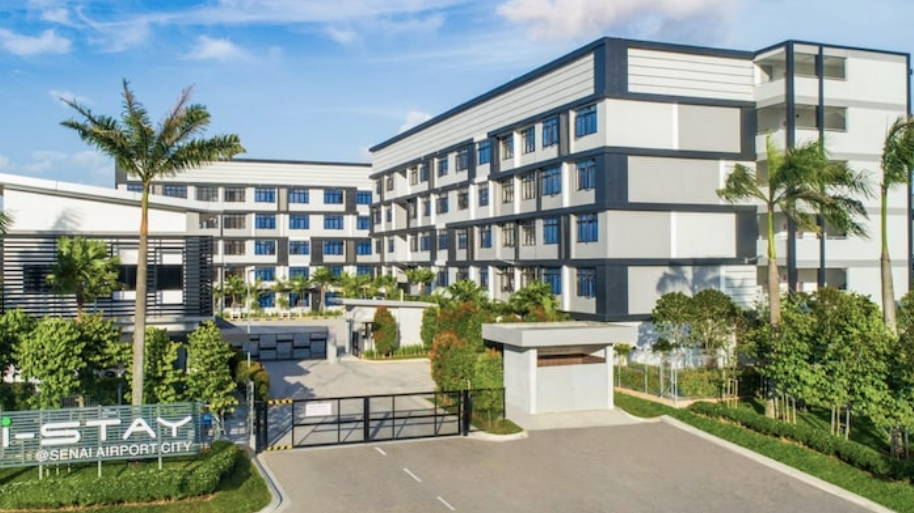
Artist rendition of Westlite Senai II worker accommodation (Image credit: Westlite Accomodation)
Worker housing as economic infrastructure
The second measure is the 10% tax deduction for converting commercial buildings into residential use. On paper, it’s a modest incentive; in practice, it could help Malaysia close a long-standing gap in safe and compliant worker housing.
Many older dormitories still fall short of Act 446 a.k.a. the Workers’ Minimum Standards of Housing and Amenities Act 1990 standards. If even a fraction of outdated stock can be upgraded through adaptive re-use, it would be a meaningful step forward for worker welfare.
Finally, the roll-out of the Outcome-Based Incentive (OBI) framework reflects a broader shift from rewarding expansion to rewarding results.
Incentives will increasingly depend on measurable outcomes, including sustainability, regional uplift and job quality. For developers, that means aligning every new project with tangible community and environmental impact – not just construction milestones.
Budget 2026 does not mention worker accommodation by name but its spirit supports the idea that decent housing is economic infrastructure. Productive factories rely on a stable, healthy workforce.
At ISP HOME DC in Johor Bahru, for example, we have seen how better living environments translate into stronger retention and morale among workers.
The facility exceeds statutory standards under Act 446, integrates solar and water-saving systems as well as fosters a sense of belonging through shared spaces and community activities.
A new standard in worker living
These are not luxuries. They are investments in continuity. When workers are housed safely and treated with dignity, everyone benefits: employers, communities and the country’s reputation as an industrial hub.
Malaysia’s industrial landscape is evolving rapidly. With renewed policy focus under Budget 2026 and continued investor attention on regions such as Johor and Penang, the bar for industrial development is rising.
Companies are no longer judged solely by how much space they build but by how responsibly and efficiently those spaces perform.
Initiatives such as the Johor-Singapore Special Economic Zone (JS-SEZ) are already driving demand for better-planned logistics hubs and compliant worker housing close to manufacturing corridors.
The next phase of growth will hinge on developers’ ability to integrate sustainability, workforce welfare and long-term operational value into every project they undertake.
Founder and Group CEO of ISP Group of Companies Eric Ng
The road ahead
The details of implementation will take time to unfold but the direction is set. The days when “industrial growth” simply meant more buildings are behind us.
The next phase is about how responsibly we build, how we use energy, how we house people and how we future-proof assets against rising expectations.
Budget 2026 offers both encouragement and accountability. For developers like us, it is a reminder that doing business responsibly is not just good ethics but about good economics. – Nov 5, 2025
Eric Ng is the founder and Group CEO of ISP Group of Companies which specialises in logistics warehouses & manufacturing hubs and purpose-built workers’ accommodation across Malaysia.
The views expressed are solely of the author and do not necessarily reflect those of Focus Malaysia.
Main image credit: Knight Frank
The post From expansion to accountability: What Budget 2026 means for Malaysia’s industrial property segment? first appeared on Focus Malaysia.
“}]]


Wenn Du einen Online Casino Bonus ohne Einzahlung bekommst, bedeutet das,
dass Du auch die Chance hast, Geld zu gewinnen, ohne das
Risiko, Dein eigenes Geld zu verlieren. Es gibt aber auch noch Freispiele, die aber meist auf einen bestimmten Slot ausgelegt sind.
Diese Art von Bonus ist der beste, den Du finden kannst,
wenn Du Geld ohne eine Einzahlung gewinnen möchtest.
Melde dich über unseren exklusiven Link an und zahle
mindestens €20 ein um dieses Angebot zu erhalten. Los geht’s mit der ersten Einzahlung,
auf die es direkt einen 100% Bonus in Höhe von bis zu
€500, plus 50 Freispiele an dem Slot Spiel ‚Book of the Fallen‘ von Pragmatic Play gibt.
Melde dich noch heute bei Lucky7Even Casino an und erhalte, auf die ersten vier Einzahlungen, Bonusguthaben im Wert von bis
zu €2.000 plus 200 Freispiele. 200% Match Bonus, plus bis zu 250 Freispiele
Zwar werden Sie mit den meisten Boni, vor allem die Willkommensboni sind hier
zu nennen, nicht zum Millionär, Sie können aber dennoch echtes Geld gewinnen. Sie erhalten dann zum Beispiel
Freispiele ohne Einzahlung. Sie finden immer mehr neue Casinos, in denen man zum
Beispiel mit Cashback oder Freispielen wirbt. So können Sie zu einem späteren Zeitpunkt
weiterspielen, denn bei der Trustly Zahlung geht nichts verloren. Wenn Sie mit echtem Geld spielen, lassen sich Gewinne auch problemlos wieder auszahlen.
References:
https://online-spielhallen.de/pelican-casino-freispiele-ihr-schlussel-zum-gluck/
To do this, you must enter that 9-digit code
in the “Another workstation” section. When you do this, you will see that a 9-digit code appearing on the left side of the screen. Its
primary purpose is to grant bidirectional remote access between personal computers and mobile devices.
AnyDesk is a free-to-use program for PCs that allows you to
access another computer remotely and securely.
Access your remote device via password without having to accept the remote session manually.
Print your files and documents from a remote device to a local printer, from any location. Turn devices on from sleep mode while connecting to them remotely.
AnyDesk ensures secure and reliable remote desktop connections for IT professionals, remote
workers, and on-the-go individuals alike. AnyDesk allows you to establish remote desktop
connections between devices and opens up unprecedented possibilities of collaborating online and administrating
your IT network.
Learn ensemble learning, its techniques, and how it works in this course!
And if you are having problem with your data
related tasks, don’t hesitate to connect
I’m also fascinated by Photography, Gaming, Music, Astronomy and learning different languages.
When hexagons come together, they form three-sided joints 120
degrees apart.
References:
https://blackcoin.co/54_highest-rtp-slots-the-14-best-paying-slot-machines_rewrite_1/
Not only classic payment methods are available, but also with the help of
cryptocurrency you can deposit or withdraw
funds. It is also worth paying special attention to the protection of player data
in the payment system, all payments are reliably protected using
the latest encryption system. The level is increased by accumulating points while playing and being
active on the platform. The Clubhouse Casino website has an extensive loyalty
programme that includes many privileges, depending on the player’s level in it.
This will give the opportunity to play and enjoy not only on a personal computer,
but also in a mobile phone.
I love the sleek and modern design of the website; it makes the gaming experience even more enjoyable.
This is one of the better casinos. I love playing with this Casino online.
Why give bonus money if you don’t pay out on it. I
thought I had won life changing money as had played for 12
hours with no contact extremely dissatisfied and wouldn’t recommend this site.
References:
https://blackcoin.co/australian-no-deposit-bonus-codes/
https://mixclassified.com/user/profile/1039924
online casinos that accept paypal
References:
onism-eg.co
australian online casinos that accept paypal
References:
walsallads.co.uk
us online casinos that accept paypal
References:
jobs.thetalentservices.com