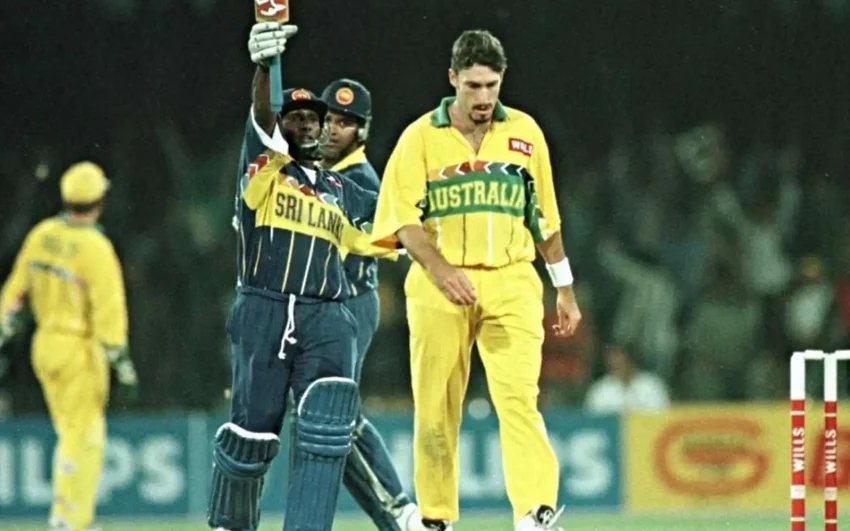

KUALA LUMPUR: Under the floodlights of Gaddafi Stadium in Lahore on March 17 in 1996, expectation gave way to something few had seen before.
Sri Lanka were not meant to win the World Cup against an Australian side featuring the Waugh brothers, Ricky Ponting, Shane Warne and Glenn McGrath.
They arrived as outsiders, still carving out their place among cricket’s established powers.
Yet over weeks of fearless play, they dismantled those assumptions and overcame severe pre-tournament turmoil in their country, including terrorism concerns, boycotts, and injuries.
The final remains etched in the game’s memory. Australia made 241, a testing total under pressure. Sri Lanka stumbled early before Aravinda de Silva took control.
His unbeaten 107 runs steadied the chase, and captain Arjuna Ranatunga guided the team home.
It was not just a win. It reshaped how one-day cricket could be played.
Three decades on, that moment is on the move again.

In May, members of the Sri Lanka 1996 World Cup team will gather in Kuala Lumpur to mark 30 years since that triumph.
The event, hosted at the Royal Selangor Club, will feature a gala dinner on May 15 and an exhibition match the following day at the Bukit Kiara ground, where the Sri Lankans will face a Rest of the World side.
The anniversary, however, carries weight beyond remembrance.
That 1996 campaign showed that teams without a long pedigree could challenge the game’s hierarchy.
It remains a reference point for countries where cricket continues to grow.
More than a celebration
For Devindran Ramanathan, the Kuala Lumpur programme must look forward as much as it looks back.
A former national cricketer, he is among those shaping the celebration. His aim is to ensure the occasion creates opportunity rather than simply revisiting history.
“This is not just about a World Cup win,” he said. “It is about showing young players what is possible.”

He sees such moments as a way to narrow the gap between aspiring cricketers and the highest level of the sport.
“When players of that stature come here, it should not stop at memories,” he said. “It must open doors.”
One of those doors will open for a group of Orang Asli schoolboys from Hulu Perak.
Devindran plans to bring about 20 youngsters from the interior to Kuala Lumpur for the weekend of May 15 and 16, giving them exposure few in their position would otherwise experience.
They will take part in a coaching clinic conducted by the Sri Lankan legends.
Each participant requires sponsorship of RM500, and organisers hope to raise at least RM10,000 to support the programme of the Orang Asli boys and provide equipment over the next three months.
For Devindran, the measure of success is clear.
“The real impact is not the match or the dinner,” he said. “It is whether a young player leaves believing they can go further.”

Inspiration beyond nostalgia
The presence of the Sri Lankan players carries meaning that extends beyond their record.
Their 1996 campaign was built on clarity of approach and a willingness to challenge convention.
The aggressive starts introduced by Sanath Jayasuriya and Romesh Kaluwitharana changed the tempo of one-day cricket and influenced how teams would play for years.
For Malaysia, where the sport continues to develop across different communities, that history offers perspective.
Progress does not always begin with scale. It often begins with intent, direction and exposure.
Moments like this can accelerate that process.
Malaysia’s former cricket captain Selvaratnam Karunakarer said while the gathering will celebrate a famous victory, “its deeper value lies in what it can spark.”
He said for those who attend the clinic, watch the match or listen to the stories, the weekend offers something direct: a connection to a defining chapter of the game.
“For young players, especially those outside traditional pathways, that connection can shift how they see the sport.
“It reduces distance. It makes the game feel reachable. And it shows that cricket’s pathways are not fixed.
“Thirty years after Sri Lanka rewrote the script, their story becomes not just a memory to admire, but a line extended forward, waiting for the next set of hands to take hold.”
To make dinner bookings and to provide sponsorship, contact Devindran Ramanathan at 019 241 1471.