FMT’s recent report on the revised Penang LRT plan was a follow-up to an earlier announcement by Mass Rapid Transit Corporation Sdn Bhd (MRT Corp), which invited public feedback from Feb 14 to May 13, 2026.
The most notable revision is the extension of the cross-channel alignment from Komtar station to Penang Sentral in Butterworth — a stretch of approximately 6km across the Penang Channel, once operated by the iconic Penang ferries.
The LRT project itself was first conceived during the Penang Transport Master Plan (PTMP) study back in 2012.
At the time, the LRT project was announced as being fully funded by the state government. MRT Corp was not involved, as it had only just been established that year and was focused exclusively on Klang Valley projects.
Although the PTMP was initiated in 2012 and adopted in 2014, the Penang LRT project faced years of delay, funding uncertainties and multiple revisions.
Controversial artificial islands
For over 10 years, the state government was unable to get the project off the ground.
The primary stumbling block was its unconventional funding mechanism, attempting to finance the LRT through large-scale land reclamation involving three controversial artificial islands in the south, now marketed as “Silicon Islands”.
Many in Penang opposed the large-scale reclamation, citing environmental concerns, coastal degradation, damage to fishing grounds, and adverse impacts on the fishing community — whose cage-based fish-farming activities risked displacement and destruction.
Silicon Islands’ reclamation caused the issues to become a real “hot potato” for the state government to handle.
Putrajaya was eventually approached, and in 2024 — after prolonged negotiations — the federal government stepped in to rescue the project, handing it over to MRT Corp with a generous budget and direct engagement with a single contractor.
This intervention effectively acknowledged that the state’s financing model was neither practical nor sustainable.
At the point of federal takeover, many critics cautioned that MRT Corp should not simply inherit the earlier state alignment wholesale.
The original plan was widely criticised for being:
- poorly structured, with weak ridership demand modelling
- overly focused on supporting the proposed Silicon Islands project
- aligned along relatively low-demand corridors
- self-serving toward Penang Island while neglecting Seberang Perai on the mainland
- failing to address major commuting patterns and key employment hubs, and
- burdened by budgets deemed excessively high relative to its value.
One glaring issue remains, the preference given to Silicon Islands — an area that currently has virtually no resident population. Yet the earlier alignment allocated three stations and an extensive depot there.
Indeed, it is difficult to justify building expensive rail infrastructure to serve a future speculative development while existing high-density areas remain underserved.
Seberang Perai neglected
In contrast, Seberang Perai has a larger population than Penang Island itself, yet it has long been sidelined in major infrastructure planning.
Congestion there is just as severe, particularly during peak hours.
Due to comparatively cheaper housing, many Penangites choose to live in Seberang Perai while commuting daily to the island for work.
This daily commuting pattern contributes significantly to chronic congestion on the Penang Bridge during morning and evening peaks.
Beyond that, major employment corridors have been overlooked:
- the Seberang Perai–Bayan Lepas industrial corridor
- the Bukit Mertajam–Butterworth axis, and
- the rapidly expanding Kulim Hi-Tech Park (KHTP) at the Penang border with Kedah.
What about Kulim?
With a population estimated at 200,000 in 2024, Kulim has emerged as a significant employment hub due to the mushrooming of high-tech and manufacturing industries.
Latest figures show that 34,000 people are currently employed at KHTP, with projections indicating that new industries slated for completion in 2026/2027 will generate an additional 24,000 positions — cementing its position as the country’s most successful high-tech park in terms of job creation.
Yet it remains outside the LRT vision entirely.
When federal funds are being used, infrastructure planning should be based on real demand and national economic impact — not speculative land reclamation projects.
It is, therefore, a positive development that MRT Corp has decided to revise this LRT plan and has now extended the line across to Butterworth, terminating at Penang Sentral.
This at least recognises that public transport planning cannot remain island-centric. It has to be demand-driven; and getting the right ridership forecast is crucial.
However, one station at Penang Sentral in Seberang Perai, is insufficient to serve the entire province of almost 900,000 people — not forgetting another 200,000 in nearby Kulim.
A single interchange station, conceptually integrated with the KTMB station, bus and ferry terminals, will not resolve systemic congestion across Seberang Perai.
The revised LRT alignment should be studied for further eastward extension between Butterworth towards the Bukit Mertajam-Kulim corridor, where employment growth is strongest.
Such a plan will strengthen the Butterworth-Komtar-Bayan Lepas rail alignment, drawing a much larger passenger catchment area connecting Kulim, Bukit Mertajam and Butterworth, integrated with cross-channel service to George Town.
These are established, high-demand commuting routes — not hypothetical future developments.
Public transport infrastructure must prioritise where people already live and work. High-density, high-employment corridors deserve rail investment far more urgently than reclaimed islands with no existing population.
In fact, the LRT depot could also be relocated, redesigned and switched over to the Seberang Perai side, where land costs is only a fraction of what is being charged on Silicon Island.
This revised plan review also needs justification in terms of passenger numbers, and the mentioned corridor has what it takes to fill up the gaping ridership figures. It presents an opportunity to correct earlier planning imbalances.
But whether that opportunity will be fully seized remains to be seen.
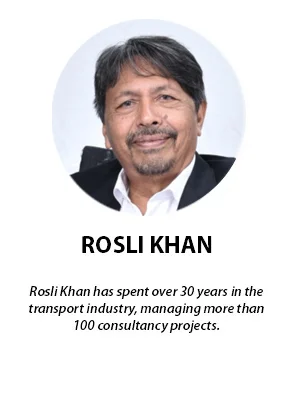
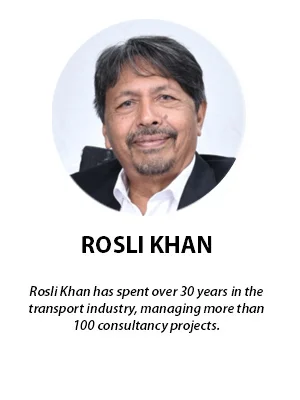
The author can be reached at: rosli@mdsconsultancy.com.
The views expressed are those of the writer and do not necessarily reflect those of FMT.