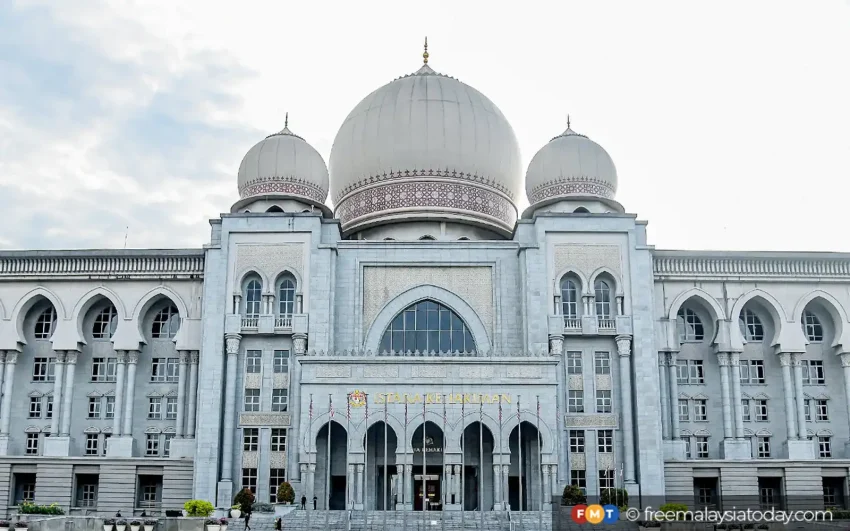

PETALING JAYA: Sarawak’s petition to challenge the validity of three national laws governing petroleum rights in the Federal Court will bring clarity to its dispute with Petronas, anchoring the matter firmly within Malaysia’s constitutional framework, an analyst says.
Samirul Ariff Othman, an adjunct lecturer at Universiti Teknologi Petronas, said the move represented a “deliberate and consequential escalation” of what was previously regarded as a regulatory disagreement involving the national oil company.
“By asking the apex court to determine the constitutional validity and continued applicability of the Petroleum Development Act 1974 (PDA) and related federal statutes to Sarawak, the state has shifted the debate’s centre of gravity,” he said in a statement to FMT.
“The question is no longer how a national oil company operates within Sarawak, but whether, and on what constitutional basis, federal petroleum laws extend to resources off Sarawak’s shores.”
On Feb 23, the Sarawak government announced that it had commenced proceedings in the Federal Court to seek clarity on the constitutionality of the PDA, the Continental Shelf Act 1966 and the Petroleum Mining Act 1966, and their application to the state.
The filing came one month after Petronas sought leave from the apex court to obtain judicial clarity on the regulatory framework governing its operations in Sarawak.
The two filings signalled that both sides were prepared to have the dispute resolved through legal channels, said Samirul.
He said Sarawak’s latest move represented a vertical escalation, from operational practice to constitutional architecture, placing the issue squarely within the realm of federalism rather than commercial regulation.
“This is not procedural flourish,” he said of Sarawak’s decision to initiate its own action instead of merely responding to Petronas’s earlier filing.
“It signals intent to define the legal terrain, to control the framing of issues, and to assert standing as a constitutional actor rather than a regulatory respondent.”
He added that the state’s posture was calibrated rather than confrontational.
“Sarawak is not rejecting the federation or questioning national unity,” he said.
“Instead, it is asserting that unresolved constitutional questions are best settled through judicial determination.”
In the same statement, Sarawak also reiterated its commitment to continued discussions with the federal government, signalling its openness to an amicable solution even as legal proceedings unfold.
Samirul welcomed the shift to a courtroom battle.
“With both Sarawak and Petronas now seeking judicial clarity, the dispute has moved decisively into institutional channels. This is, on balance, a stabilising development,” he said.
“For investors and counterparties, a rules-based process, however complex, is preferable to prolonged ambiguity driven by informal bargaining or public signalling.”
He added that the involvement of the Federal Court anchored the dispute within Malaysia’s constitutional framework and affirmed that even politically sensitive questions can be resolved through legal means.
Samirul said the court’s eventual ruling could take several paths, from reaffirming the continued applicability of the federal petroleum framework to recalibrating aspects of federal and state authority.
“At one end of the spectrum lies a reaffirmation of the continued applicability of the federal petroleum framework. This would reinforce Malaysia’s long-standing national model and offer the least disruptive path for existing contracts and operations,” he said.
“At the other end lies a partial or substantial recalibration of federal reach in Sarawak. Such an outcome would mark a structural inflection point, requiring careful sequencing to avoid regulatory overlap and investor dislocation.”
He also pointed to a more pragmatic possibility in which judicial clarification is followed by a structured political settlement.
“Courts often illuminate the contours of authority without dictating every operational detail,” he said, noting that implementation would still require coordination between federal and state authorities.
Ultimately, Samirul said the episode should be read as a test of Malaysia’s federal maturity.
“For a country that is not a resource superpower, scale, coordination and institutional credibility have always mattered as much as geology,” he said.
“Handled carefully, this moment could strengthen Malaysia’s constitutional order by replacing ambiguity with clarity.”