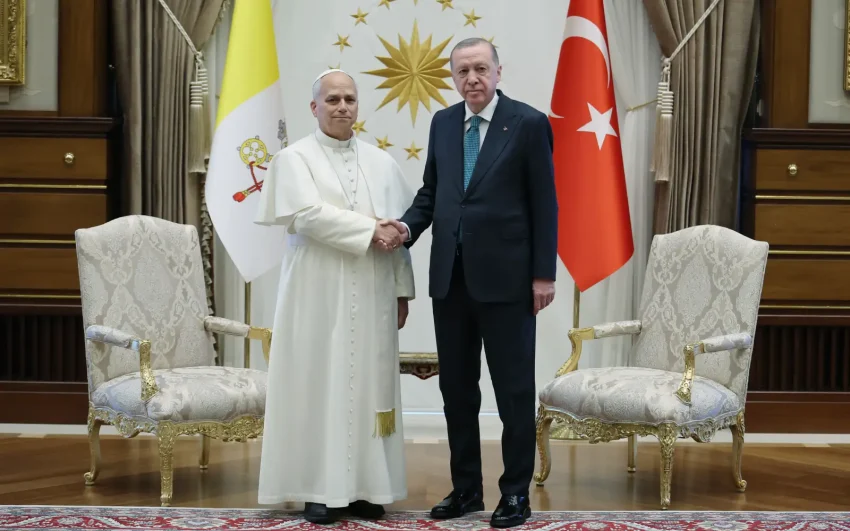
Pope Leo XIV meets Turkish President Recep Tayyip Erdogan during his first trip outside Italy as pontiff. (Turkish Presidential Press Office/EPA Images pic)
ANKARA: Pope Leo on Thursday urged Turkey to embrace its role as a mediator between nations after holding talks with President Recep Tayyip Erdogan, on the first overseas trip of his papacy.
“Mr President, may Turkey be a source of stability and rapprochement between peoples, in service of a just and lasting peace,” he told officials and diplomats in the capital, Ankara, at the start of a four-day visit.
“Today more than ever, we need people who will promote dialogue and practise it, with firm will and patient resolve,” he said, warning of “a heightened level of conflict on the global level”.
Turkey increasingly positioned itself as a key mediator alongside major Western powers, regularly taking part in conflict-resolution efforts from the Ukraine conflict to the Gaza war, the Horn of Africa and beyond.
Turkey had a “special role” as a bridge between East and West, Asia and Europe, but was also “a crossroads of sensibilities” which was richer for its internal diversity, Leo said.
“You have an important place in both the present and future of the Mediterranean, and of the whole world, above all by valuing your internal diversity,” he said in a country that counts some 100,000 Christians among a population of 86 million, mostly Sunni Muslims.
“Uniformity would be an impoverishment. Indeed, a society is alive if it has a plurality,” he said.
“Christians desire to contribute positively to the unity of your country. They are — and they feel — part of Turkish identity.”
The leader of the world’s Catholics also said it was “essential”, in a society like Turkey where religion plays a visible role, “to honour the dignity and freedom” of everyone.
“We are all children of God, and this has personal, social and political implications,” he said.
“Today, this is a great challenge, which must reshape local policies and international relations.”